You didn't accumulate eight different research informatics platforms because of bad planning. You did it because no single platform does everything well.
Your choices made perfect tactical sense at the time:
- Platform 1 handles compound registration brilliantly, but its Bio ELN falls short
- Platform 2 excels at chemistry ELN, but struggles with assay data
- Platform 3 owns assay data management, but you need a separate application for visualization & analytics…
- …except that the visualization app doesn't handle med chem design cycles well
The result? Process fragmentation hell.
The Hidden Costs of "Best of Breed"
While each platform decision was optimized for a specific use case, the collective result creates systemic inefficiencies that compound over time. Researchers rotate through five to ten different logins daily, each with its own interface, search paradigm, and data model. CSV export-import cycles consume hours each week as scientists manually bridge platforms that should communicate automatically. The same compound data lives in three systems with slightly different structures, creating version control nightmares — and nobody is quite sure which system holds the authoritative registry or the definitive assay results.
Each new tool requires custom development to connect with existing platforms, and those integrations break with every platform update. Meanwhile, license costs creep upward: you're paying per-user fees for multiple platforms, growing annually, even though each researcher uses only a fraction of any given platform's features.
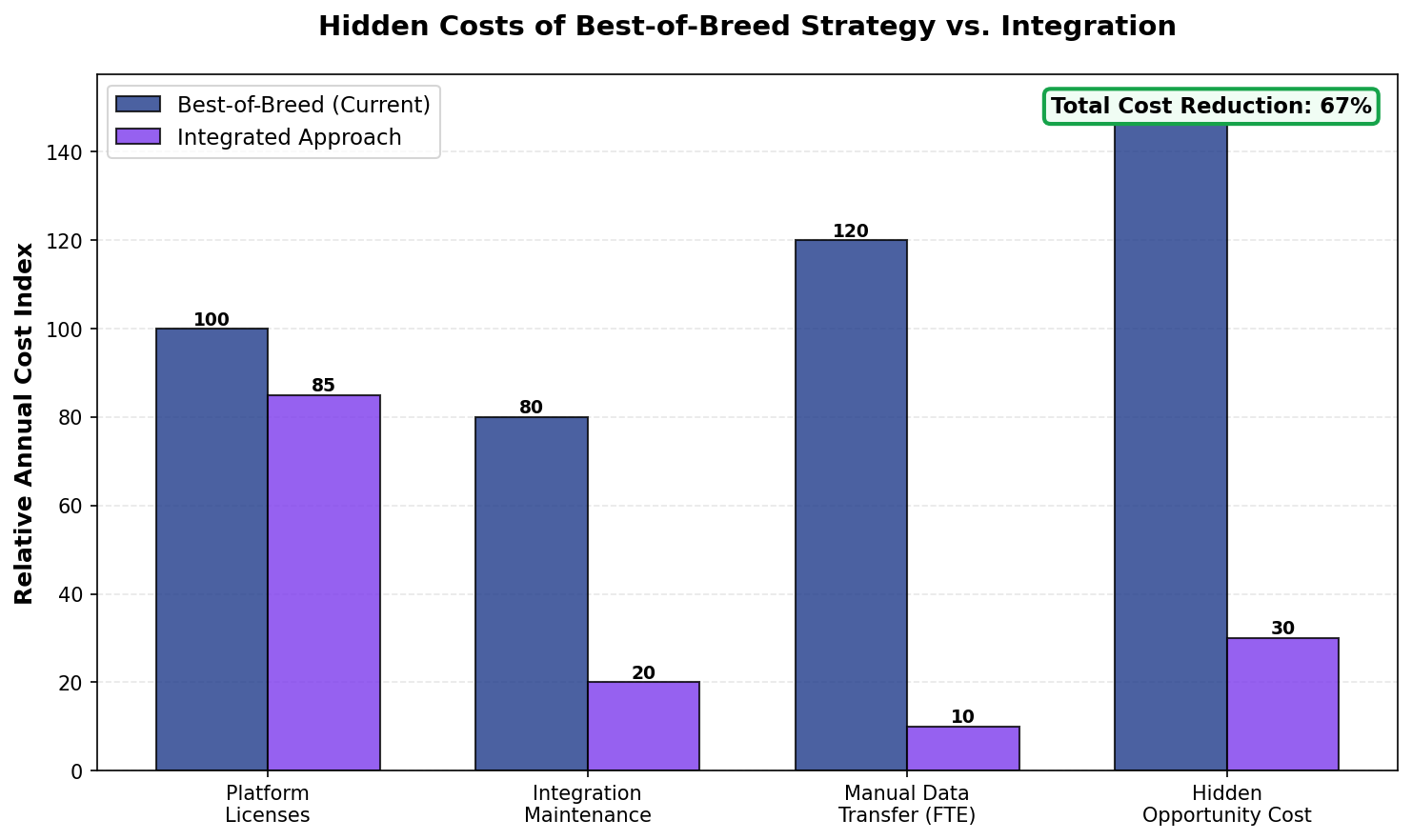
The hidden tax of fragmentation, and what integration recovers.
These aren't minor inconveniences — they're structural impediments to scientific productivity. Your informatics infrastructure has become a drag on discovery rather than an accelerant.
A Different Approach: Integration Over Replacement
Here's what we don't do: try to sell you another platform that promises to "do everything." You've heard that pitch before, and you know how it ends.
Instead, Workflow Informatics builds the connective tissue that makes your existing best-of-breed tools work as a unified system. We call this "integration over replacement," and it fundamentally changes the economics and risk profile of informatics modernization.
What This Looks Like in Practice
Rather than forcing researchers to export data from your ELN, manually format it for your visualization tool, then upload it back, we build automated data pipelines that sync in real time. The compound a med chem scientist registers from your chemistry ELN appears immediately in your computational chemistry platform and your assay data system, with complete provenance tracking.
When your biologists generate assay results in Dotmatics, those results flow automatically to your Spotfire dashboards and your LiveDesign structure-activity analysis — no CSV files, no manual uploads, no version conflicts. Everyone sees the same data, in their preferred tools, updated in real time.
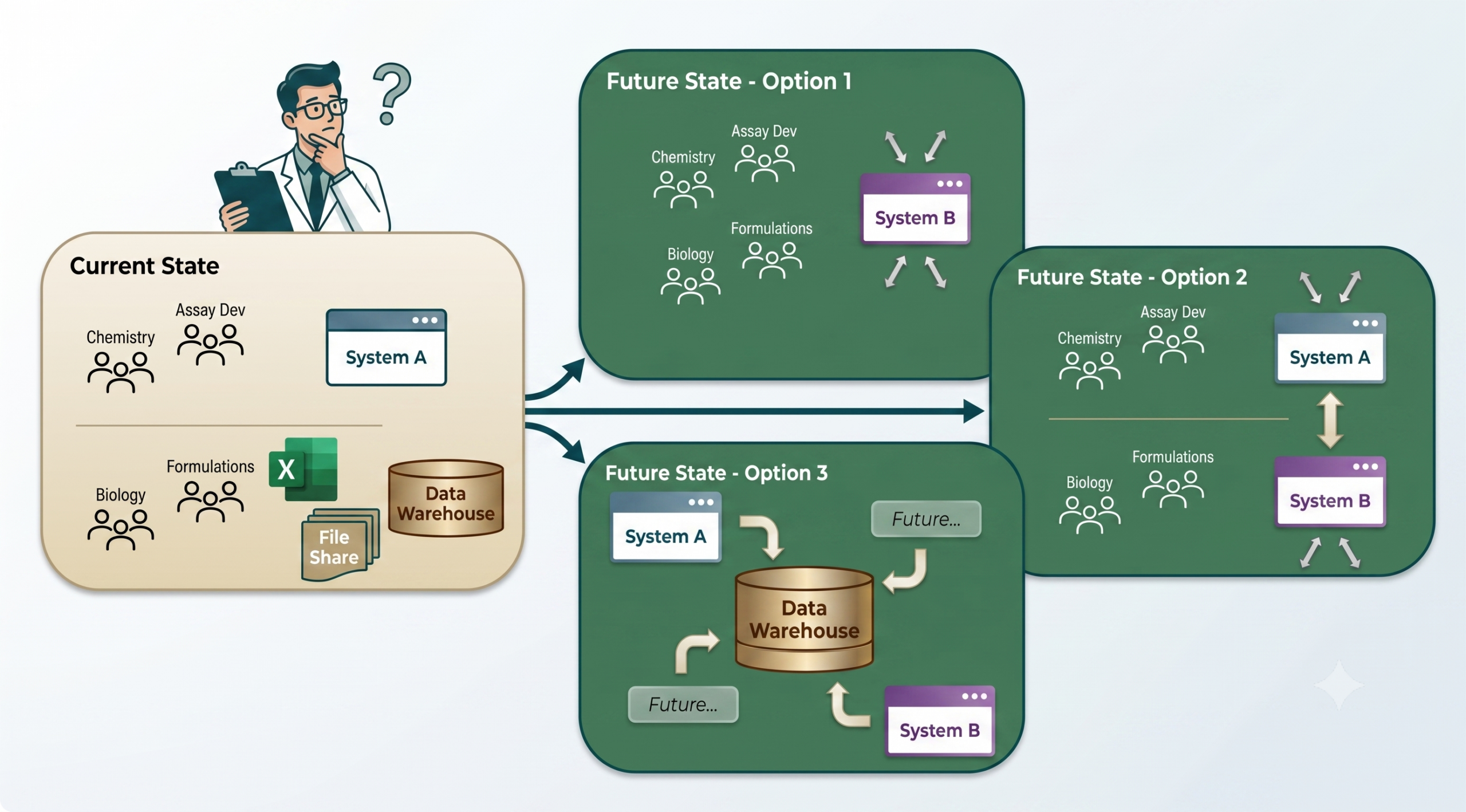
From disconnected systems to a unified, synced research environment.
This approach preserves your investment in platforms where they excel, eliminates manual data movement, and creates a unified research environment without forcing platform consolidation.
The Path Forward
Most organizations we work with don't need new software. They need their existing software to work together. That requires three capabilities: deep technical expertise in the APIs, data models, and authentication patterns of major research informatics platforms; scientific domain knowledge to know which data transformations preserve scientific meaning and which introduce artifacts; and workflow understanding to design integrations that match how scientists actually work, not how platforms think they should work.
This is the intersection where Workflow Informatics operates. We're not platform vendors trying to replace your stack — we're integration specialists who make your existing investments work harder.
The question isn't whether to consolidate platforms or add new ones. The question is whether your existing platforms are delivering their full value, or if data fragmentation is leaving significant capability on the table.
In most cases, better integration delivers more value than platform replacement — at lower cost and lower risk.
As specialists in scientific research informatics, our most common requests are for integrating and migrating laboratory and data systems. We have extensive experience with the platforms drug discovery organizations actually use, and we understand both their strengths and their limitations.
Common scenarios we handle:
- Migrate legacy data from hundreds of Excel sheets to assay data management systems like Dotmatics
- Integrate CDD Vault with Spotfire for advanced visualization and analysis
- Connect Benchling with Schrödinger's LiveDesign to facilitate new compound design workflows
- Migrate data between ELN platforms while preserving scientific context
- Implement scheduled, automated import of CRO ELN experiments to your internal ELN
- Build data warehouses and automated syncs from disconnected platforms
Our software scientists have experience with Dotmatics, Benchling, Sapio, Genedata, CDD Vault, Schrödinger, StarDrop, Revvity/Spotfire, D360, Titian Mosaic, and many more — using best practices including the BiochemUDM standard.
Reach out to info@workflowinformatics.com to schedule a discussion.
We're excited to announce our continued partnership with Sapio Sciences, a leader in laboratory informatics platforms for life sciences organizations.
As Sapio Sciences noted in their recent announcement, they welcomed Workflow Informatics as a partner at SapioCon 2026, citing a shared focus on understanding both the technology and the science behind discovery work.
The partnership reflects our shared commitment to practical delivery: helping teams align technology with how work actually gets done in the lab. It's a model for how we work across the informatics ecosystem — bringing together best-of-breed platforms through thoughtful integration rather than attempting to replace existing investments.
Boston · February 18–19, 2026
Workflow Informatics will be attending SapioCon 2026 in Boston. This conference brings together laboratory informatics professionals, scientific software vendors, and life sciences organizations to discuss the latest advances in research technology.
If you're dealing with challenges around platform integration, data migration, or workflow optimization, we'd welcome the chance to discuss your specific situation.
Topics we're interested in discussing:
- Integrating best-of-breed platforms without creating data silos
- Migration approaches that preserve scientific context and data quality
- Automation opportunities in laboratory workflows and data pipelines
- Cloud deployment strategies for scientific informatics platforms
Want to connect? Reach out to info@workflowinformatics.com, or learn more about SapioCon 2026.